Eight points to bear in mind before, during and after sport – from adjusting your insulin to changing the catheter.
1. Reduce the insulin supply
The following questions are important in order to adjust insulin therapy correctly before, during and after physical activity:
When do I want to be physically active? (Is the bolus or the basal rate acting?)
How much insulin is active at that time?
How much do I need to reduce:
- 50–90% for the bolus, depending on the time until the start of exercise
- Reduce the basal rate at least 1–2 hours before the start of exercise
How long and how intensively do I want to exercise?
- The more intense, the greater the reduction in %.
How long does the planned physical activity continue to have an effect?
- The more intense and the longer the exertion, the longer its after-effect.
- Reduce the basal rate by 20–50% in the 8–12 hours after the end of exertion
2. Increase carbohydrate intake
Either slow-acting carbohydrates well before the start of exertion (1–2 hours) or very fast-acting carbohydrates directly before exertion
During exertion, take 1–2 carbohydrate units (CU) in liquid form every 15–20 minutes. Avoid slowly absorbed carbohydrates during exertion.
After sport: bear in mind the muscle refilling effect! Possibly continue to increase carbohydrate intake
3. Take in fluids
If the starting blood sugar is above the renal threshold (approx. 160 mg/dl), athletes with diabetes must drink more fluid before and during sport than people with a healthy metabolism
Carbohydrate-containing fluids are best suited during sport
4. Measure blood sugar
Blood sugar must always be measured before any physical activity.
Most athletes with diabetes aim for a starting blood sugar of 150–180 mg/dl (8.5–10 mmol/l), depending on the amount of insulin currently acting, their level of training and other factors.
For dangerous sports, a higher „safety blood sugar“ is advisable.
5. Measure ketones
If blood sugar levels are above 250 mg/dl (14 mmol/l) or there are symptoms of ketoacidosis, a ketone test must be carried out (in athletes, in the blood)!
Ketone test in the normal range (blood test up to 0.5 mmol/l or urine test negative or 1+)
You can start physical activity, but must repeat the blood sugar test and, if necessary, the ketone test at close intervals.
Blood ketone test slightly elevated (0.6–1.0 mmol/l)
No physical activity recommended.
Ketone test significantly elevated (blood test from 1.1 mmol/l or urine test ++ or +++)
No physical activity – start emergency treatment instead!
6. Take an „SOS sports kit“ with you
People with diabetes should not go anywhere, let alone run, without a sufficient amount of emergency CU.
SOS sports kit for all-day activities:
Blood glucose meter, sufficient test strips, lancing device, blood ketone meter
Insulin, glucagon syringe, syringes, pens
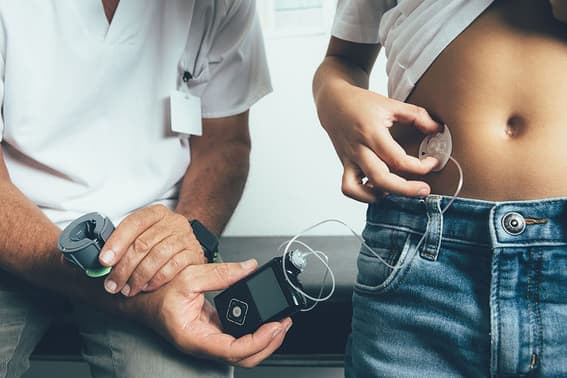
Insulin pump: batteries, spare catheters and similar
Sufficient fluids
Sufficient amounts of „fast“ carbohydrates (cola, glucose gel, dextrose etc.)
Sufficient amounts of „slow“ carbohydrates (fruit, bread, energy or cereal bars etc.)
7. CGM and sport
Start sport with a rising glucose trend
Program a sports profile:
- 120 mg/dl for the „low blood sugar“ alarm
- Set the pre-alarm as sensitively as possible (usually 2 mg/min)
- 220 to 250 mg/dl for the „high blood sugar“ alarm, or deactivate it
- The „high blood sugar expected“ pre-alarm can be switched off.
Additionally secure the CGM transmitter and insulin pump catheter with Fixomull stretch® or kinesio tape
8. Changing the catheter after sport or training is advisable
Especially with a reduced basal rate and increased blood flow to the tissue, backflow of tissue fluid or blood can lead to marked rises in blood sugar after the end of sport.
Further information on diabetes and sport: Diabetes- und Sportfibel, Diabetes und Sport Jahrbuch, www.idaa.de
User guide taken from: Diabetes- und Sportfibel: Ulrike Thurm, Bernhard Gehr – €19.90 / CHF 33.90, ISBN 978-3-87409-457-3, 3rd edition 2009, 446 pages, paperback, DIN A5
Do you have questions about this article? Call us or write to us – we are happy to help.